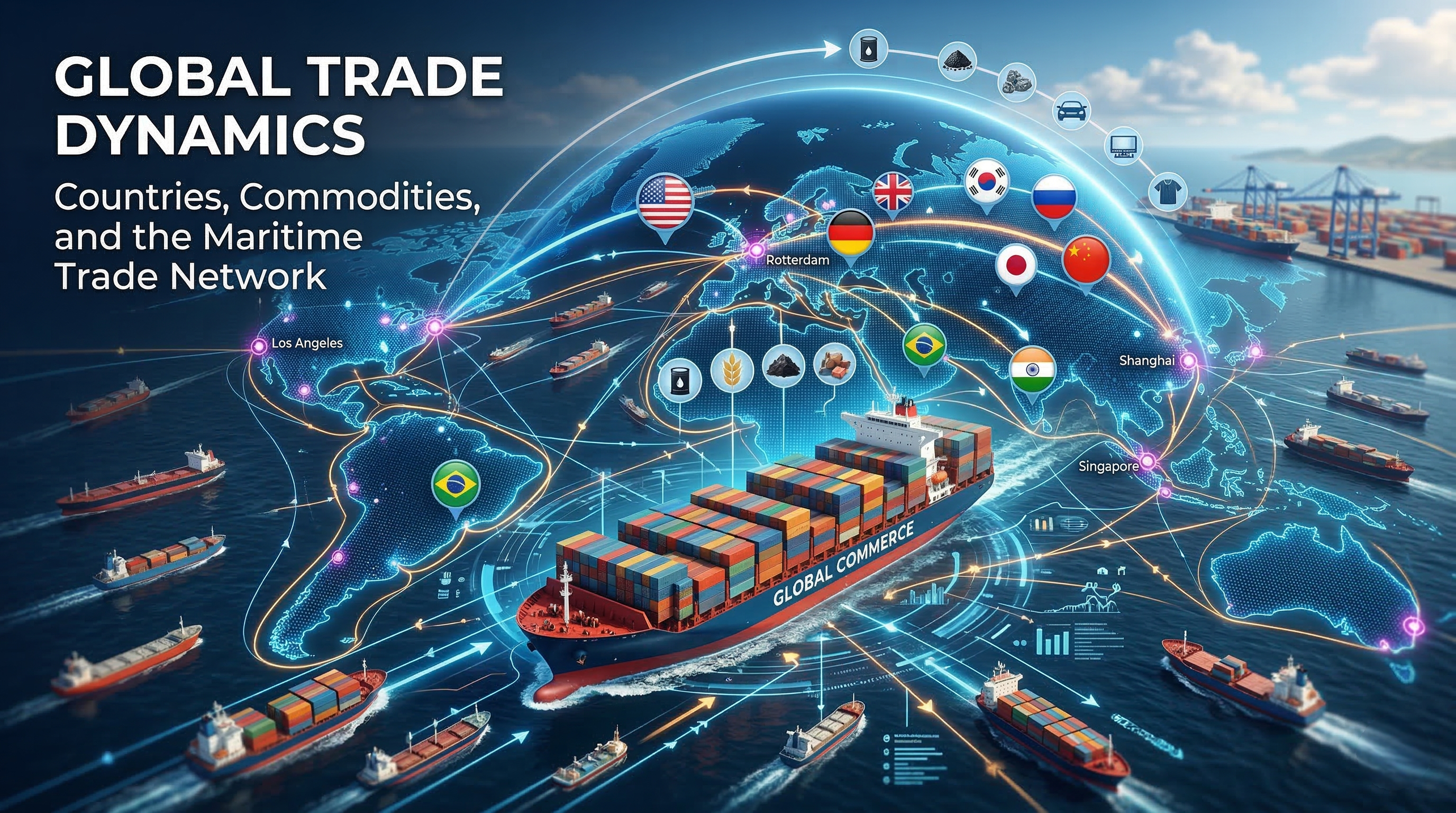
Introduction
International trade is one of the most powerful engines of global economic growth. The movement of goods across borders allows countries to specialize in production, optimize resource allocation, and integrate into global value chains. Over the past three decades, globalization and technological progress have dramatically expanded the scale of international commerce.
According to the latest global trade statistics, global merchandise exports reached approximately $24.5 trillion in 2024, while the broader value of total global trade in goods and services exceeded $32 trillion. These figures highlight the immense scale of cross-border economic activity in the modern world economy.
Maritime transportation forms the backbone of this system. Approximately 80–90% of global merchandise trade by volume is transported via sea, making oceans, canals, and strategic maritime routes critical infrastructure for international exports.
This article presents a data-driven analysis of global exports, focusing on the major exporting countries, key commodities traded internationally, the role of maritime trade routes, and the emerging trends shaping the future of global commerce.
Global Export Landscape
Growth of Global Trade
The scale of global trade has expanded significantly since the mid-20th century.
| Year | Global Merchandise Exports |
| 1950 | $61 billion |
| 1980 | $2 trillion |
| 2000 | $6.4 trillion |
| 2010 | $15 trillion |
| 2024 | ~$24.5 trillion |
Over the past seventy years, global merchandise exports have increased more than 400 times, reflecting the rise of globalization, industrialization, and technological innovation.
Despite disruptions such as the COVID-19 pandemic, geopolitical tensions, and supply chain shocks, global trade has demonstrated remarkable resilience.
Leading Exporting Countries
Global exports are highly concentrated among a small number of advanced manufacturing economies.
Top Exporting Countries (Approximate Merchandise Exports)
| Rank | Country | Export Value |
| 1 | China | ~$3.6 trillion |
| 2 | United States | ~$1.9 trillion |
| 3 | Germany | ~$1.55 trillion |
| 4 | Japan | ~$739 billion |
| 5 | South Korea | ~$721 billion |
| 6 | Netherlands | ~$640 billion |
| 7 | Italy | ~$620 billion |
| 8 | France | ~$610 billion |
| 9 | Hong Kong | ~$570 billion |
| 10 | Singapore | ~$560 billion |
China alone accounts for approximately 15% of global exports, making it the dominant player in global manufacturing supply chains.
Key Factors Driving Export Leadership
Several structural factors explain why these countries dominate global exports:
- Industrial capacity and manufacturing scale
- Advanced logistics and port infrastructure
- Participation in global supply chains
- Technological innovation and high-value production
China’s manufacturing ecosystem, Germany’s industrial machinery sector, and South Korea’s electronics industry illustrate how specialization drives export competitiveness.
Major Global Export Commodities
International trade consists of thousands of products, but a relatively small number of categories dominate export value.
- Manufactured Goods
Manufactured products represent approximately 70% of global merchandise exports.
Major manufactured exports include:
- Electronics and semiconductors
- Automobiles
- Industrial machinery
- Telecommunications equipment
- Consumer electronics
Key exporters of manufactured goods:
- China
- Germany
- Japan
- South Korea
- United States
Semiconductors have become one of the most strategic commodities in global trade due to their importance in artificial intelligence, electronics, and automotive technology.
- Energy Commodities
Energy exports play a crucial role in global trade.
Major energy commodities include:
- Crude oil
- Natural gas
- Refined petroleum products
- Coal
Leading energy exporters:
| Country | Major Export |
| Saudi Arabia | Crude oil |
| Russia | Oil and natural gas |
| United States | LNG and refined petroleum |
| UAE | Oil |
| Qatar | Liquefied natural gas |
Energy exports heavily influence global geopolitics and economic stability, as energy supply disruptions can cause significant price volatility.
- Agricultural Commodities
Agricultural trade is essential for global food security.
Major agricultural exports include:
- Wheat
- Rice
- Corn
- Soybeans
- Palm oil
- Coffee
Key agricultural exporters:
| Country | Major Export |
| United States | Corn, soybeans |
| Brazil | Soybeans, beef |
| India | Rice, spices |
| Indonesia | Palm oil |
| Argentina | Wheat, soybeans |
Agricultural exports are typically transported via bulk cargo ships across major maritime routes.
- Minerals and Metals
Mining exports support global industrial production.
Major mineral exports include:
- Iron ore
- Copper
- Aluminum
- Lithium
- Gold
Leading exporters:
| Country | Major Resource |
| Australia | Iron ore |
| Chile | Copper |
| Brazil | Iron ore |
| South Africa | Platinum and gold |
| Democratic Republic of Congo | Cobalt |
These commodities are critical inputs for manufacturing industries worldwide.
Maritime Trade and Global Shipping Routes
Maritime transport remains the most cost-efficient method for transporting bulk commodities and manufactured goods.
Modern container ships can carry over 20,000 containers, dramatically lowering transportation costs.
Major Global Shipping Routes
Three primary ocean trade corridors dominate global maritime commerce.
- Asia–Europe Route
This route connects East Asia’s manufacturing hubs with European markets via the Indian Ocean and the Suez Canal.
Major exports along this route include:
- Electronics
- Machinery
- Automobiles
- Textiles
- Trans-Pacific Route
This route connects Asia with North America.
Major exports include:
- Consumer electronics
- Industrial machinery
- Automotive parts
- Retail goods
The United States is one of the largest import destinations along this route.
- Trans-Atlantic Route
This route connects Europe and North America.
Major exports include:
- Pharmaceuticals
- Industrial machinery
- Aerospace products
- Luxury goods
Strategic Maritime Chokepoints
Several narrow waterways carry a disproportionate share of global trade.
Key Global Trade Chokepoints
| Chokepoint | Importance |
| Strait of Malacca | Asia’s primary shipping corridor |
| Strait of Hormuz | Major oil export route |
| Suez Canal | Connects Asia and Europe |
| Panama Canal | Connects Atlantic and Pacific trade |
| Bab-el-Mandeb | Connects Red Sea to Indian Ocean |
Disruptions in these chokepoints can significantly affect global supply chains.
Regional Export Dynamics
Asia
Asia has emerged as the global manufacturing hub, accounting for the largest share of world exports.
Key exporting countries include:
- China
- Japan
- South Korea
- Vietnam
- India
Europe
Europe focuses on high-value industrial exports.
Major export sectors include:
- Automotive manufacturing
- Industrial machinery
- Chemicals
- Pharmaceuticals
Germany remains Europe’s largest exporter.
Americas
The Americas export both commodities and advanced technology products.
Major exports include:
- Agricultural commodities
- Energy resources
- Technology products
The United States remains a leader in high-technology exports and services trade.
Emerging Trends in Global Trade
- Rise of Technology-Driven Exports
Demand for semiconductors, artificial intelligence hardware, and electric vehicles is reshaping global trade patterns.
- Growth of Services Trade
Services such as:
- Financial services
- Software and IT
- Digital platforms
now account for over 27% of global trade.
- Supply Chain Diversification
Companies are diversifying supply chains to reduce geopolitical risk and improve resilience.
Countries such as Vietnam, India, and Mexico are emerging as new manufacturing hubs.
- Green Trade and Energy Transition
The transition toward renewable energy is increasing trade in:
- Lithium
- Rare earth metals
- Solar panels
- Electric vehicles
These sectors are expected to dominate future export growth.
Conclusion
Global exports form the foundation of the modern global economy. With merchandise trade exceeding $24 trillion annually, international commerce connects industries, markets, and consumers across continents. Leading exporters such as China, the United States, and Germany dominate global trade flows, while commodities ranging from electronics and automobiles to oil and agricultural products sustain global supply chains.
Maritime transport infrastructure—including oceans, canals, and strategic chokepoints—remains essential for facilitating these trade flows. As technological innovation, geopolitical dynamics, and sustainability priorities reshape the global economy, the structure of international trade will continue to evolve.
Understanding the patterns, drivers, and risks of global exports will remain crucial for policymakers, investors, and businesses navigating the increasingly interconnected world economy.
References / Sources
- World Trade Organization (WTO). World Trade Statistical Review 2024. Geneva: WTO.
- United Nations Conference on Trade and Development (UNCTAD). Global Trade Update 2025. Geneva: UNCTAD.
- United Nations Conference on Trade and Development (UNCTAD). Review of Maritime Transport 2023. Geneva: UNCTAD.
- World Bank. Commodity Markets Outlook 2024. Washington, D.C.: World Bank.
- International Monetary Fund (IMF). World Economic Outlook 2024. Washington, D.C.: IMF.
- Food and Agriculture Organization of the United Nations (FAO). The State of Agricultural Commodity Markets 2024. Rome: FAO.
- International Energy Agency (IEA). World Energy Outlook 2024. Paris: IEA.
- BP. Statistical Review of World Energy 2024. London: BP.
- Organisation for Economic Co-operation and Development (OECD). International Trade by Commodity Statistics 2024. Paris: OECD.
- World Shipping Council. Global Container Shipping Industry Report 2024.
- UNCTAD. Handbook of Statistics 2024. Geneva: UNCTAD.
- WTO. Trade Statistics and Outlook Report 2024. Geneva: WTO.
- United Nations Statistics Division (UN Comtrade Database). International Trade Statistics.
- International Chamber of Shipping. Shipping and World Trade Report 2023.
- World Bank. Global Economic Prospects 2024. Washington, D.C.: World Bank.
Disclaimer
This article is intended for informational and educational purposes only. It presents a general overview of global export trends, major trading countries, commodity flows, and maritime trade routes based on publicly available data from international organizations and research publications.
The statistics, estimates, and interpretations referenced in this article are derived from sources such as the World Trade Organization (WTO), United Nations Conference on Trade and Development (UNCTAD), World Bank, International Monetary Fund (IMF), and other recognized institutions. While reasonable efforts have been made to ensure accuracy, global trade data may be subject to revisions, methodological updates, and varying reporting standards across countries.
The content does not constitute economic, investment, trade, or policy advice. Readers should refer to official publications and consult relevant experts before making business, financial, or policy decisions based on the information presented.
The author and publisher assume no responsibility for any actions taken or decisions made based on the contents of this article.