Over the past few years, Environmental, Social, and Governance (ESG) has become a major focus in the corporate world. Investors, customers, employees, and regulators increasingly expect companies to operate responsibly—not just profitably. This shift has sparked an ongoing debate: do ESG initiatives help or hurt profitability, or can companies achieve both realistically? Understanding ESG and … Read More “ESG vs. Profitability: Can Companies Balance Both?” »
Category: Featured
The commodity segment of capital markets is the organized platform where commodities are traded through derivative contracts such as futures and options. Unlike equities, which represent ownership in a company. The commodity segment in Indian Capital Markets is a specialized area that allows trading in commodities like metals, agricultural products and energy. This segment is … Read More “The Commodity Segment of Capital Markets in India” »
India is among the most varied and populous nations in the world. Its demographic situation is a complicated combination of age composition, population increase, religion, language and rural-urban distribution. Understanding India’s demographics is essential for analyzing its social, economic, and political development. Population Size and Growth India is currently the most populous country in the … Read More “Demographics of India” »
Family businesses are one of the main strengths of worldwide economies. These businesses are either local small shops to large international corporations such as Walmart and Ford that are crucial in the creation of employment, stability of the community, and economic development. However, with the rapid development of the markets, family businesses have their specific … Read More “Family-Owned Businesses: Resilience and Challenges in Modern Markets” »
Dependence on imports has become a typical feature of most of the emerging economies in the context of a globalized economy. With the integration of the countries into the world trading systems, countries tend to be very dependent on imported goods and services to sustain a domestic demand, help the industry evolve, and find new … Read More “Import Dependency: Risks and Opportunities for Emerging Economies” »
Over the past few years, the Environmental, Social, and Governance (ESG) issues shifted to the peripheral zone of corporate responsibility to the core of business strategy. The Social dimension of the three-pillar has become more prominent, and the Diversity and Inclusion (D&I) is currently becoming a major priority among organizations that want to achieve long-term … Read More “Diversity and Inclusion as an ESG Priority” »
The global energy transition is the paradigm transition of moving the energy system who relies on fossil fuels toward cleaner, renewable, and more sustainable energy sources, including solar, wind, hydro, nuclear, and new technologies like green hydrogen. Several forces have led to this change through the issues of climate change, technological advancement, energy security, and … Read More “Global Energy Transition and Its Impact on Economies” »
Introduction Shipping and logistics constitute the core of the global trade by carrying more than 80% of total goods of the world. The industry is currently facing pressure because of the rapid climatic change, governments with their ambitious climate targets, and the expectations placed on the industry to move towards lower emissions. This action is … Read More “The Future of Shipping and Logistics in a Carbon-Neutral World” »
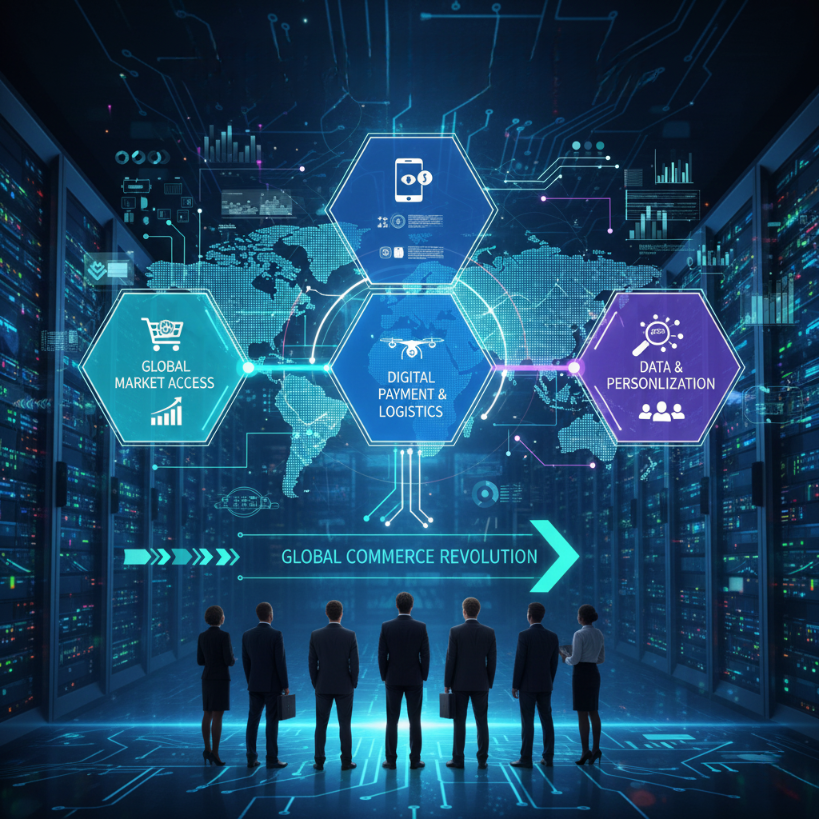
Over the last twenty years, e-commerce and online trade has evolved into a marginal online business to form a major component of the global economy. What started as mere online purchases has now become a complex digital environment that is continental, industry, and consumer-market-wide. Digital trade is currently not only transforming the nature of buying … Read More “E-commerce and Digital Trade: The New Frontier of Global Commerce” »
Over the decades, the chief financial officer (CFO) had been largely referred to as the custodian of financial reporting, cost control and compliance. Although these roles can be considered core, with the digital age, the role of the CFO is changing radically. The modern CFO is not just the protector of financial integrity, but he … Read More “The Changing Role of CFOs in the Digital Age” »