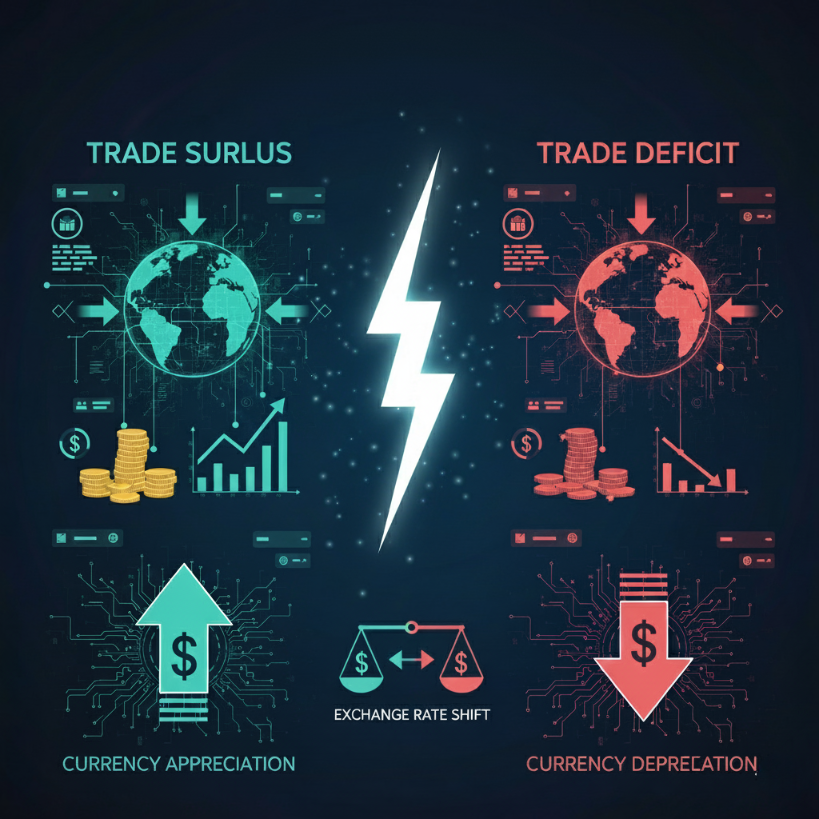
The modern economy is based on the global trade, which unites countries with the help of exchanging goods, services, and capital. However, lurking below such an extensive web of trade is a very serious and misinterpreted phenomenon, which is trade imbalances. Such imbalances be they in terms of deficits or surpluses in terms of trade have a pronounced influence in the currency movements. The implications of a trade flow on the exchange rates are crucial in the business operations of investors, businesses and policymakers in the global financial environment that is interlocked.
Concepts of Trade Imbalances
Trade imbalance is the condition that exists when imports and exports of a country in terms of goods and services are dissimilar.
When a country sells more than it buys, then there is trade surplus.
A deficit in trade on the other hand may happen when imports are higher than exports.
Ideally, once trade between the nations is balanced with time. But in practice, due to many other things, including variations in production capacity, consumer demand, competitiveness, and fiscal policy, there are always surpluses or deficits. These imbalances have direct impacts on foreign exchange (forex) markets, where the currencies are purchased and sold.
The Relationship Between Trade Flows and the Demand of Currency
All the global transactions are associated with the exchange of currency. In case a foreign buyer buys goods or services overseas they have to exchange their own currency with the currency of the exporter. This activity generates a demand of currency of the exporter and the supply of currency of the importer.
As an example, when the US imports machinery in Germany, the American consumers must use euros to pay the German exporters. This augments demand on euro and supply of U.S dollar which exerts upward pressure on the euro and downward pressure on the dollar.
With time, these flows become accumulated. The countries which experience high and chronic surplus of trade (such as China, Japan, or Germany) would experience appreciation pressure on their currencies. On the other hand, nations that are chronically under trade (i.e. U.S, U.K, or India) tend to experience depreciation pressure.
Mechanics of Trade Deficits and Currency Depreciation
A negative in the balance of trade means that the nation is importing more in terms of the value of goods and services than it will be able to earn in terms of its exports. The country will have to finance this deficit by borrowing overseas or by the inflow of capital – e.g., foreign investment in its bonds, equities or businesses.
First, the capital inflows would be able to maintain the currency neutralizing the adverse impact of the trade deficit. But when the deficit continues and the investor confidence dwindles, the demand of the domestic currency reduces, and hence, the currency becomes depreciated.
The advantages and the disadvantages of depreciation are:
Advantages: A devalued currency will lower the price of exports and make it more competitive in the international market and in the long run this will reduce the level of trade deficit.
Disadvantages: It raises the cost of imports which adds to inflation and lowers the purchasing power of the consumers.
In the United States of America, the U.S. dollar has been an exception by being strengthened even amidst the long-term trade deficits. This is mostly due to the reserve currency status, confidence of the world in the U.S. financial markets and steady inflow of capital. Other countries that run deficits such as Turkey or Argentina have however been hit with a steep fall in their currency as investor sentiment reversed to the negative.
Surpluses on Trade and Appreciation of Currency
On the contrary, surplus in trade generates steady demand of the currency of a country. By making purchases of exports, the foreign buyer is forced to buy the currency of the exporter which increases its worth in the international markets.
The example of Japan and Germany is that both the yen and the euro have had a positive history in the performance of exportation. On the same note, the yuan of China has been under the threat of appreciation owing to its huge trade surpluses. Nevertheless, most of the surplus countries step in to avoid overstrengthing the currency – which will increase the costs of their exports and render them uncompetitive.
In order to control this the central banks at times buy foreign currencies or build up reserves (in U.S. dollars). This holds their currency down below what it would otherwise be – a policy that is often scolded as currency manipulation. A case in point of such intervention is the hoarding of U.S. Treasuries by China in the 2000s in large amounts.
The Current Account and Capital flows Role
The current account that contains the balance of trade, investment earnings and transfer payment should equal the capital account – which shows the foreign investment flows.
Mathematically: Current Account + Capital Account = 0
This implies that when a nation has a trade deficit (negative current account), it has to have a positive capital account, which must be obtained either through foreign investments or foreign borrowing. On the other hand, a surplus of trade country will normally sell capital to other countries investing in other economies.
These capital flows help in realizing why movement of currency does not necessarily reflect trade imbalance in the short run. For instance:
A country that has a trade deficit may experience a strong currency provided that the assets that are offered by this country are appealing to foreign investors.
A country that has a trade surplus may experience a stable or weak currency provided that it spends a lot of money abroad or when the bank of the country actively intervenes.
Real-life illustrations
The United States
The U.S. has been experiencing decades of sustained trade deficits. Nevertheless, the dollar has continued to be the major world currency and this is backed up by huge capital inflow, world confidence and international trade and finance. The dollar paradox demonstrates that trade processes may be overwhelmed by capital markets, at least when it comes to reserve currency countries.
China
The maintained trade surpluses that China experienced during the 2000s and 2010s caused the yuan to appreciate to a great extent. But the government stepped in with massive measures to stabilize the currency staying competitive in exports. China kept the increase of the yuan down by regulating the flow of capital, and this showed how policy can influence the natural effect of trade imbalances.
Japan
The trade surpluses in Japan in the 1980s and 1990s gave rise to the appreciation of the Yen factor which added to the asset bubbles and consequently deflation. The yen was comparatively high even at those later times when the trade surplus of Japan was low even though the latter was narrowed thus indicating the demand on safe haven during foreign time of doubt.
Effects in the Short and Long- Term
In the short run, currency changes usually respond to capital flows, interest rate differentials and investor sentiment and not trade per se. Traders are interested in the location where they get the most good, and therefore a country with higher yields or what is considered to be a stable environment may have a higher attraction of capital even in cases where a country has a trade deficit.
However, in the long run, the mechanisms of adjustment of the trade imbalances to the currency will repair:
Deficit normally causes depreciation of currency, which increases exports and reduces imports.
Excess supply is a common cause of appreciation which decreases the competitiveness of export and promotes imports.
This is the self-correcting mechanism of international macroeconomics – but the government policies, speculative flows and structural considerations can slow it down or corrupt it.
Conclusion
The imbalances in trade are not mere figures in the balance sheet of a country but they are the very building blocks of the currency valuation and financial stability of the world. When a nation experiences a trade surplus, its currency will appreciate as the foreign demand will be high. On the other hand, the continued trade deficits put pressure on the currency which, however, may be overridden by capital inflows.
In the modern globalized world, where capital flows, investor confidence and interventionist policies are influential factors, the linkage between balance of trade and currencies is complicated and indisputable. In the long-run, currencies are likely to represent external competitiveness, financial discipline, and international confidence of any nation, which are strongly determined by the ratio between what a country exports to the global market and what imports.
After all, knowing about trade imbalances is not only informative in as far as the forex trends, but it tells about the health and sustainability of the economic model in the country.
Disclaimer
This article is intended solely for informational and educational purposes. It provides general economic analysis on trade imbalances, currency dynamics, and international financial flows. The content should not be interpreted as financial advice, investment recommendations, trading guidance, or policy direction.
While the information presented is based on widely accepted economic theories, historical trends, and publicly available data believed to be reliable, the author does not guarantee the accuracy, completeness, or current relevance of any facts, examples, or interpretations. References to specific countries, economic policies, or currency movements are included strictly for explanatory purposes.
The views expressed are general in nature and do not consider the specific financial situation, objectives, or risk profile of any individual, investor, or institution. Readers should not rely solely on this material when making financial, investment, or policy decisions.
The author and publisher disclaim any liability for losses, actions, or consequences arising directly or indirectly from the use or interpretation of this content. For professional advice, readers are encouraged to consult qualified economists, financial experts, or relevant regulatory authorities.